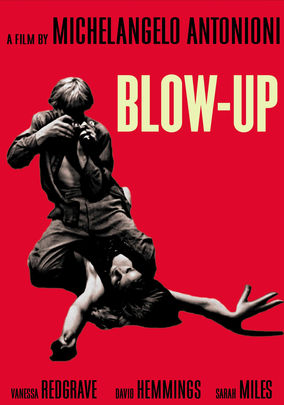
Blow-Up-1966
Director Michelangelo Antonioni
Starring David Hemmings, Vanessa Redgrave
Top 250 Films #75
Scott’s Review #305
Reviewed December 21, 2015
Grade: A
Blow-up is a mysterious and compelling 1966 (the spawn of more edgy films) thriller that undoubtedly influenced the yet-to-come 1974 masterpiece The Conversation, directed by Francis Ford Coppola, as both films are tense tales of intrigue focusing on technology as a tool to witness a murder.
This film is legendary director Michelangelo Antonioni’s first English-speaking film, and what a film it is.
Set in hip London in the 1960s, it is undoubtedly a fascinating portrayal of the fashion world. The story is about a fashion photographer named Thomas, who is in high demand. He revels in bedding women so they may have their photos taken by this rock star photographer and is chased around London by gorgeous women.
One day, he aborts a photo shoot because he is bored. He is not the nicest guy in the world, but an unlikable character.
But perhaps that is secondary or even intentional. One day, while walking in Maryon Park, he encounters a couple in the distance. They appear to be having a secret rendezvous and nervously kissing, so he begins photographing the woman, Jane (played by a very young Vanessa Redgrave). Jane realizes they have been snapped and is furious, demanding the film.
This sets off the mystery and the meat of the film.
The film is a tremendous achievement in cinematic intrigue. It is pretty psychological and open to much interpretation, which is its genius. The main questions are: “What exactly transpired in the park, and who is responsible?”
We feel little sympathy for Thomas, which perhaps is intentional. And what about Jane?
Talk about a mystery!
We know little about her beyond the fact that she has secrets, but is she responsible for the crime? Throughout the film, Thomas and Jane engage in a cat-and-mouse game, seemingly trying to outwit and outmaneuver each other.
The unique aspect of the film is that the viewer will often ask questions: “Was there even a crime committed?” “Are the events all in Thomas’s imagination, or has he misinterpreted the series”? One will revel in the magnificence of these questions.
I immediately recognized similarities to The Conversation (1974). Both feature one of the senses as a means of solving or realizing the crime committed—in The Conversation, it is hearing; in Blow-Up, it is sight.
In both, the main character uses these senses for a living, and both are arguably not the most likable characters. Both films feature mimes. Both films are pretty cerebral, and both are cinema gems for the “thinking man.”
Blow-Up has weird, little intricate moments- a very tall female Russian model experiences an odd photoshoot with Thomas. Later, a giggling pair of young girls end up in a grappling match with Thomas after asking him to take their photos. A topless (from behind) Jane prancing around Thomas’s apartment is an unusual scene.
As a first-time viewer, I adored this film. It is a good example of a movie that requires multiple viewings to appreciate fully, and I look forward to doing just that.
A fantastic, creative achievement, Blow-Up (1966) is a masterpiece that can be dissected with each subsequent viewing.
Oscar Nominations: Best Director, Michelangelo Antonioni, Best Story, and Screenplay Written Directly for the Screen