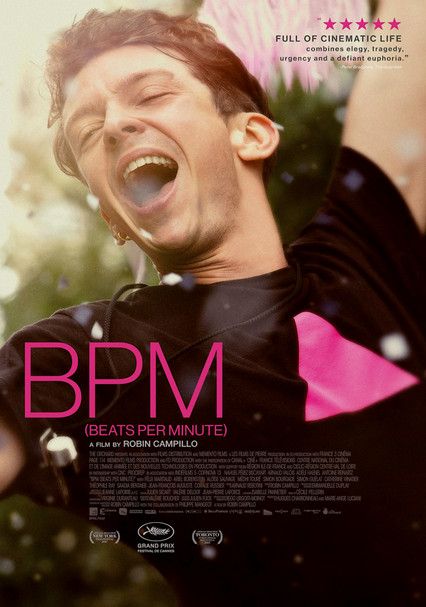
BPM (Beats Per Minute)- 2017
Director Robin Campillo
Starring Nahuel Perez Biscayart, Arnaud Valois
Scott’s Review #884
Reviewed April 11, 2019
Grade: A-
BPM (Beats Per Minute) (2017) is an exhilarating and heartbreaking film. It elicits emotional reactions such as empathy and empowerment and channels a potential life-saving cause.
Of French language and shot documentary style, the film is not an easy watch as the viewer is transplanted back to the early 1990s when the AIDS epidemic was ravaging the world in general and the gay community specifically.
A mixture of a community-oriented movement and a love story makes this project worthwhile viewing.
The immediate focal point of the story is an impassioned and aggressive Paris-based chapter of ACT UP (AIDS Coalition to Unleash Power), a unified gay and lesbian organization intent on speeding up the French government’s response to the unwieldy AIDS epidemic.
The group resorts to extreme public protests consisting of fake bloodthrowing and invading prominent pharmaceutical company meetings. They intend to get them to release trial results immediately instead of waiting until the following year.
The various debates and infighting in the chapter are heavily featured.
As the film progresses, BPM (Beats Per Minute) slowly shifts its focus from the protests to the personal lives of the ACT UP members as a romance brews between nineteen-year-old HIV-positive Sean (Perez Biscayart), who already exhibits visible infections from the disease, and HIV negative Nathan (Valois), a newcomer to the group.
The pair quickly become inseparable as Sean’s body becomes ravaged by the disease, resulting in a poignant and dire conclusion sure to elicit tears.
Director Campillo and co-screenwriter Philippe Mangeot drew on their personal experiences with ACT UP in developing the story, enriching the authenticity of the experience.
Despite being shot in the present day, the film feels genuine, with a 1990s feel and flavor. Though gorgeous and picturesque, the gray Parisian locales also portray a hint of sadness and bleakness.
As Sean gazes outside, we sense his fear and anguish. Through this character, Campillo and Mangeot provide personal stories that represent the plight of many at that time.
A particularly racy scene erupts approximately halfway through the film as Sean and Nathan’s love story takes center stage.
Foreign-language films are not known for shying away from nudity or sexuality as many American films do. As the impassioned pair make love for the first time, little is left to the imagination.
Despite the gratuitous nudity and the overt sexual tones, the duo’s relationship is not solely physical, and the audience will undoubtedly come to care for both men the way that I did.
The two-fold story is a wise choice, and the overall message that BPM (Beats Per Minute) presents is inspiring and a good telling of the LGBT community’s struggles at notice and inclusion during the 1980s and 1990s.
This point is both positive and negative. The story beckons back to a day in the community’s history, dripping with pain and loneliness, which is evident in the film.
The film is hardly a happy experience and quite somewhat a downer.
The film’s main drawback is its length. The story and principle points become redundant at nearly two and a half hours, causing the overall message to lose some of its thunder.
The constant bickering and debate among the ACT UP group become tedious to watch as fight and clash after fight and clash resurface repeatedly.
Though painful to experience and not very uplifting, BPM (Beats Per Minute) (2017) is an important film to view, given how far the treatments of HIV have progressed over several decades.
Not taking things for granted, a trip down memory lane for those alive during the epidemic is recommended.
For those fortunate enough to have missed the 1980s and the 1990s, the film is a necessary reminder of how life once was for the unfortunate victim of a devastating epidemic.
Independent Spirit Award Nominations: Best International Film