Bread and Chocolate-1974
Director Franco Brusati
Starring Nino Manfredi, Anna Karina
Scott’s Review #996
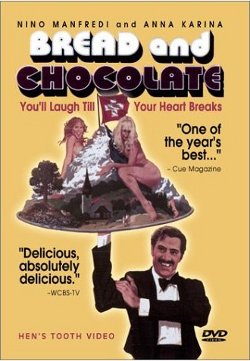
Reviewed March 6, 2020
Grade: B
Bread and Chocolate (1974), known in Italian as Pane e cioccolata, is a mixed dramatic and comedic offering by Franco Brusati, a well-known Italian screenwriter and director.
The film is charming and tells of one man’s trials and tribulations trying to make it as a migrant worker in a foreign country- in this case, neighboring Switzerland. He is conflicted by the opportunities presented and the catastrophic way his life is screwed up at every turn.
The film is meaningful and poignant, but sometimes has no clear path. A commonality is the representation of differing cultures.
Nino (Nino Manfredi) is a hard-working Sicilian man who heads for Switzerland in search of a better life- the time is the 1960s or the 1970s, when this was a common occurrence. Despite his best efforts to fit in with his neighbors, he never quite seems to make it, haplessly going from one situation to the next.
He befriends a Greek woman named Elena, a refugee who harbors secrets, and is supported by her for a time. He forages a career as a waiter and befriends a busser.
As his luck dwindles, he is reduced to finding shelter with a group of Neapolitans living in a chicken coop, surviving on the same chickens they tend.
With bizarre gusto, they frequently emulate the chickens, strangely parading around their quarters like animals.
The main character, Nino, reminds me of the character Roberto Benigni played in the 1997 gem Life Is Beautiful. In that film, Guido tries to shelter his son from the horrors of war.
In Bread and Chocolate, Nino has a zest for life, using humor to survive and get through daily situations, slowly realizing his dire straits.
Both characters are scrappy and daring: Nino humorously urinating on a tree or awkwardly stumbling upon a dead body in the woods.
The film’s theme centers on the conflict between staying in Switzerland to find a better life and returning in shame to his homeland, Italy, which is assumed to be a failure. Nino constantly wrestles with this quandary and discusses this point with his family photos in his bedroom.
In two instances, he nearly gets on a train headed back to Italy but changes his mind. The film does not do a great job explaining or showing what is so awful back in Italy.
Bread and Chocolate is difficult to categorize because it is neither a straight-ahead comedy nor pure drama. As the film progresses, it loses some of its situational comedy in favor of melancholy and sadness.
I am not sure this is a great decision, as we often wonder whether we should laugh with Nino or feel bad for him. Perhaps both?
The film scores big on comedy, as evidenced by several laugh-out-loud restaurant scenes. Nino, clearly not knowing what he is doing, struggles to peel an orange properly to serve a guest. He emulates another waiter with hilarious results.
Later, he offends a snobbish, sophisticated woman after she blames him for causing her to fall to the floor.
The strangest scene occurs when the chicken people spy on four gorgeous Swiss siblings bathing in a nearby river. Gorgeous and tranquil, they are the definition of stunning and lush.
Charmed by the idyllic vision of the group, Nino decides to dye his hair and pass himself off as a local. The images of the cackling and dirty Italian people, with their snickering and drooling, set against the peaceful family, are both beautiful and odd.
The scene could almost be featured in an Ingmar Bergman art film.
Bread and Chocolate (1974) is a film about a man’s journey that can be classified as an adventure, drama, art film, or comedy, and sometimes crosses genres too much.
The comedic antics draw rave reviews, but the film slips a bit when it ventures into dramatic territory, becoming middling and overly preachy.
Actor Nino Manfredi breathes all the life he can into a film that is appealing, but not quite marvelous.