Tag Archives: Harriet Andersson

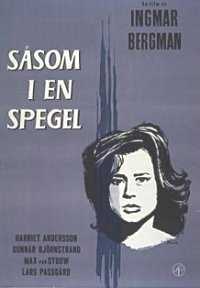
Through a Glass Darkly-1961

Through a Glass Darkly-1961

Director Ingmar Bergman

Starring Harriet Andersson, Gunnar Björnstrand, Max von Sydow

Scott’s Review #1,377
Reviewed July 15, 2023

Grade: A

I recently acquired a robust Ingmar Bergman collection featuring over three dozen of the great director’s works, so I have much introspective filmmaking to look forward to.

Considered visionary, influential, and many other stellar adjectives, his films are personal and human. They are frequently dark and not easy to watch, but the payoff is significant for the patient cinephile.

His 1961 work, Through a Glass Darkly (1961), tells the story of a schizophrenic young woman, Karin (Harriet Andersson), vacationing on a remote island with her husband Martin (Max von Sydow), novelist father David (Gunnar Björnstrand), and frustrated younger brother Minus (Lars Passgård).

She has been released from the hospital and plans to enjoy the summer tranquility at the family’s quaint cottage.

She slowly unravels as the reality sets in that she may not get better, and the family is aware of this.

The story is told in a brisk twenty-four-hour period and consists of only four characters. It is structured as a three-act play that runs for ninety-one minutes.

Let’s remember that mental illness was not as advanced in 1961 as it is decades later. Most who suffered from it were tossed away into a ‘loony bin’ and quickly discarded from society.

Delving into such controversial and unpleasant territory in 1961 deserves enormous accolades.

The brilliance of Through a Glass Darkly is how Karin realizes her mental illness and its fateful ravages. She is aware of what’s happening to her and that she will never recover. After all, the hen’s mother also had a mental illness.

Her rich characterization is powerfully played by Andersson, who stands out in the film. This could be because of Sven Nykvist’s cinematography, but sometimes Karin looks like a little girl and, at other times, a haggard older woman.

I wonder if Bergman was trying to show the parallel between Karin and her mother.

Speaking of the camerawork, as in Bergman’s films, the black-and-white style only enhances the quality of the picture. The contrast between black and white and the frequent close-ups of the characters reveal glowing and ghostlike facial images.

I champion shots like this because they enrich the visual perspective and shift away from the story.

Andersson is not the only excellent actor; second place belongs to Björnstrand as the father. His character is a writer and deeply pained. Revealed to have tried to commit suicide,e he is riddled with guilt, regret, and desperation.

Von Sydow is decent as Karin’s husband, but the actor has much better Bergman roles to reflect on. Any cinema lover will associate the great actor with The Seventh Seal (1957).

Towards the end of Through a Glass Darkly, I didn’t quite connect the dots when the characters go into detail about how god is equated with love.

I focused on Karin and the other characters coming to terms with the fact that she would go to an asylum and never return.

What Bergman does so well in Through a Glass Darkly is making the audience envelop the characters, accepting and feeling their pain. I despair with Karin when she imagines a spider emerging from the walls and crawling on her.

Of course, the audience doesn’t see what Karin imagines, which makes the scene much scarier than if Bergman had shown a giant spider.

One’s imagination is always worse than what is on the screen.

Requiring patience and a deep dive into despair, Through a Glass Darkly (1961) is worth the work. Lovely beachside images and beautiful sunlight mix perfectly with anguish and depression, creating an intimate experience.

Oscar Nominations: 1 win-Best Foreign Language Film (won), Best Original Screenplay

The Girls-1968

The Girls-1968

Director Mai Zetterling

Starring Bibi Andersson, Harriet Andersson

Scott’s Review #404

70052262

Reviewed May 11, 2016

Grade: B+

The Girls is a 1968 Swedish film that is political, surreal, dreamlike, and feminist. These may seem like too many adjectives to describe a movie, but they all happen to be warranted and work to categorize it, which is tough- it is a complex film.

The film left me deep in thought about what I had just viewed- that is a positive for me.

Directed by Mai Zetterling, a woman, the film is told from a female perspective and is quite tricky to follow. However, the message portrayed is a compelling thought of a woman repressed, whether in reality or fantasy, by men.

In my attempt to describe The Girls accurately, it appears to feature a boys-versus-girls element throughout, told by the girls. The plot centers around three women: Liz (Bibi Andersson), Marianne (Harriet Andersson), and Gunilla (Gunnel Lindblom).

The women are hired to star in a touring production of Lysistrata, and each faces conflict and concern over leaving their respective families, but for differing reasons.

Liz’s husband, who is having an affair, cannot get rid of her soon enough. Marianne has recently dumped her married boyfriend. Gunilla has four children and suffers from guilt.  All of the women are very friendly with each other.

All three principal actresses are familiar to eagle-eyed Ingmar Bergman fans as each of them has appeared in numerous films of his-in very different types of roles.

Wild Strawberries and The Seventh Seal (both 1957) feature these actresses.

The women go on tour and have various surreal experiences based on the play in which they are stars. The film, made in black and white, has very overexposed cinematography. The blacks and the whites look very sharp, and this is no doubt done deliberately.

On the surface, it would appear that the women hate men and yearn to be free of them. Is that the point of the film? It seems to go in other directions as well. Do they hate their lives and feel confined with men and free without them, when they are touring their play?

How do they feel about their children? Do they miss them on tour, love them, resent them, or perhaps a bit of each? They yearn to be free of restraint.

We are treated to numerous scenes that seem to be a dreamlike state or a fantasy of one of the women. One runs through the forest and comes upon a grizzled, dirty child on the ground. Is it hers? She then sees her husband sitting in a living room chair in the middle of the forest.

The symbolism resonating through The Girls is countless. We also see the women fantasize about a handsome, young man. Are they tired of the doldrums- looks and otherwise- that their husbands have caused them?

Many political protests occur throughout the film. In one, the women march in unison- Nazi-style and chant. In another, the women lead what appears to be a charge of women-suffragette style, until the women start attacking each other and punching and kicking each other in the streets.

These scenes and countless others are tough to analyze, but perhaps this is the point. I decided to escape into the film and not try to figure out what everything meant.

Fantastic to see the exterior scenes shot in Stockholm, Sweden, which reminds us what a liberal, democratic city it is. Yet the women are repressed. Made in 1968, during the sexual revolution, the film’s timing is perfect.

The Girls (1968) left me pondering the story and the viewpoint, and I will need further viewings for the film to sink in more successfully and for me to get it, if I ever do, but I enjoyed it nonetheless.

The film is the kind of film that requires further viewing to understand. I look forward to watching this film again, which is high praise.