Pain and Glory-2019
Director Pedro Almodovar
Starring Antonio Banderas, Penélope Cruz
Scott’s Review #1,042
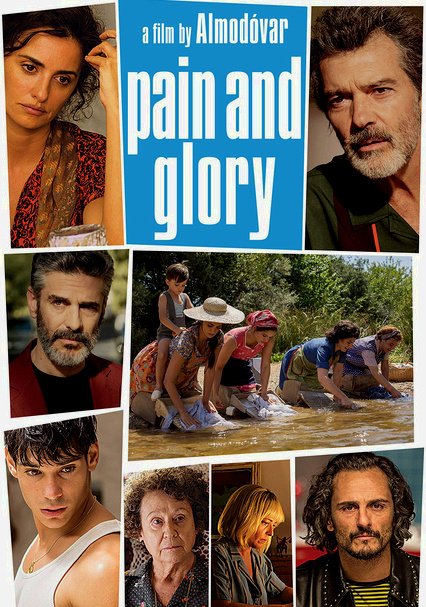
Reviewed July 20, 2020
Grade: A-
Thought to be director Pedro Almodóvar’s most personal effort to date, Pain and Glory (2019) showcases the talents of actor Antonio Banderas, who has been appearing in Almodóvar’s films since 1982.
A character study, the film poetically reflects on the life of an aging filmmaker (Banderas) who yearns to rediscover his lost creative spirit while reminiscing about his first love.
The triumphant film could have been faster-paced, but above all, it celebrates life, regret, and pain, and is thus inspiring.
Salvador Mallo (Banderas) is a once well-known filmmaker who is now personally and professionally on the decline. He suffers from health maladies, leaving him in chronic pain, and has lost his knack for crafting good projects.
When he runs into an old friend and actress, Zulema (Cecilia Roth), who barely acts anymore and is reduced to accepting any roles offered to her, he decides to visit the lead actor from his best-known film, Sabor.
Salvador hasn’t spoken to Alberto (Asier Etxeandia) in thirty years, and both ruminate over the film as it is to be remastered and celebrated.
Once a subject of contention, Salvador and Alberto begin to smoke heroin, prompting Salvador to revisit his childhood memories, rediscovering life. His most prominent memory is when he, his father, and his mother, Jacinta (played by Penélope Cruz), move to a whitewashed cave to live.
There he meets and befriends an older laborer, whom he teaches to read. Salvador discovers his sexuality through this young man after seeing him naked.
Years later, during the 1980s, Salvador falls madly in love with Federico (Leonardo Sbaraglia), and the pair share a passionate love affair that deteriorates at the end of the decade.
In the present day, Federico reemerges and tracks down Salvador. They reconnect, sharing drinks and memories, nearly reigniting their passion. Federico is now married to a woman and raising kids in Argentina, but the powerful memories resurface, and the men flirt and gaze at one another longingly.
The film utterly belongs to Banderas. The actor has charisma in many other roles, but Salvador might be his crowning achievement.
It’s such a personal role and was written specifically for the actor by Almodóvar. He possesses the ability to grasp the viewer in his clutches and never let go.
From the agonizing pain he experiences daily, causing him to choke for no reason, to his inability to fulfill his now elderly mother’s dying wish to die in her village after accusing him of never loving her, we empathize with him every step of the way.
His sexuality was discovered and revealed at a young age. Salvador’s longing and unfulfilled passion are the most intricate and nuanced aspects of the film.
As the laborer draws a picture of Salvador, which he later rediscovered, an unspoken passion develops between the youngsters.
In later years, his assistant nudges him to look the laborer up via Google, to see where he is, perhaps reconnecting. Salvador refuses, sinking into regret of what might have been.
To build on this, his fling with Federico as a young man, shown via flashbacks, is powerful. The scene, in which a teary Federico, in present times, sits in a theater weeping while watching Salvador’s play, is a testament to his love for the man.
The unknown is why the relationship failed, and Federico gave up on men and succumbed to a traditional relationship. However, we can only guess that Salvador might not have been able to commit.
When the men spend an evening together, capped off with a passionate kiss but nothing more, we realize how they could have built a wonderful life together.
Props to Sbaraglia for a tremendous performance in a small role.
Assuredly, Pain and Glory were patterned after 8 1/2, a 1963 masterpiece penned and directed by Federico Fellini.
The themes of regret, writer’s block, and memories come into play throughout both films. Almodóvar even names Salvador’s lover Federico, an obvious tribute to the famous director, known for infusing stylistic touches and non-linear stories.
Like most of Almodóvar’s other projects, Pain and Glory explores themes of vibrant colors, sexuality, and passion. Set in Madrid, the film boasts a zesty, cultured Spanish flair, characterized by blues, greens, and oranges.
Even though the overarching theme is loss, pain, and missed opportunities, the film remains rich in energy and pizzazz. For those with a fondness for acting, cinema, or creativity, there is enough to satisfy.
After decades in the spotlight, crafting film after film with resounding results, Pain and Glory (2019) may be the cream of the crop for the Spanish director.
Thanks in large part to the tremendous efforts of a legendary actor, the experience will please fans of the directors and anyone with a taste for a film about zest for life, unfulfilled pleasures, and new experiences.
Oscar Nominations: Best Actor-Antonio Banderas, Best International Feature Film