Faster, Pussycat! Kill! Kill!- 1965
Director Russ Meyer
Starring Tura Satana, Haji
Top 250 Films #93
Scott’s Review #406
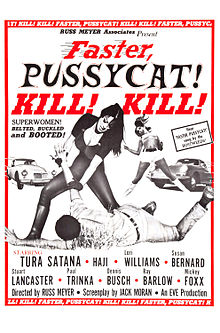
Reviewed May 28, 2016
Grade: A
Faster, Pussycat! Kill! Kill! is a 1965 masterpiece that has eluded me for many years, primarily because it is not available on Netflix.
Finally, I decided to buy the newly released Blu-Ray edition and immediately became a massive fan of this Russ Meyer work of art.
Influential and intriguing, it is no surprise that it is a camp classic.
Several famous directors, like Quentin Tarantino, have paid homage to this film in their later works, notably Death Proof (2007). Fast cars, sexy women, and murder are the hallmarks of this unique film.
Compared to other famous Meyer works, specifically the gregarious yet brilliant Supervixens (1975), Faster, Pussycat! Kill! Kill! is almost understated and quiet.
He also directed the well-known Beyond the Valley of the Dolls from 1970.
Shot in black and white, several notable comparisons to Supervixens are: a hot California desert, large-breasted women, and gas stations are prevalent throughout.
Unlike Supervixens, though, there is little or no nudity.
Three go-go dancers race through the desert in their sports cars. They have murder and kidnapping on their minds. The ring leader, Varla (Tura Satana), is a vicious, sexy, Asian woman. Her two sidekicks are Billie (Lori Williams) and Rosie (Haji). While Billie and Rosie fight in a juvenile fashion, Varla is the serious one.
The trio enjoys racing their cars and engaging in the game “chicken.” When they meet the all-American couple, Tommy and Linda, out for a romantic drive, they have a dispute and end up killing Tommy, drugging and kidnapping Linda.
After stopping for gas, Varla hatches a plot to steal money from a crazy older man, his muscular yet dimwitted son (known as the Vegetable), and the older man’s seemingly normal son, Kirk.
Faster, Pussycat! Kill! Kill! is a groundbreaking film because it subverts traditional gender roles. The women are hardly written as sex objects, as most films of that day were far from that. They are ferocious, specifically Varla, and they do typically masculine things. They race cars, fight, and kill, yet they do not sacrifice any of their femininity.
All three women are attractive and busty, and they wear stylish makeup. They are not trying to be like men but tough girls, and these aspects make the film so wonderful to watch.
In Hollywood, these female characters are often portrayed as molls to even rougher men or as supporting characters who aid the men in some way. These female characters are the film.
My favorite character is Varla. Sexy, fierce, and a minority, how often is a female villain this charismatic? Perhaps she would be a conquest for Bond in the Bond films, not her person.
Varla makes up her own rules. The fact that she is Asian is superb and breaks many barriers to how Asians are portrayed in the film. Varla is more devious than the other characters and is willing to kill anyone who stands in her way, even her friends.
She is a character skillfully written by Russ Meyer and is a quintessential femme fatale.
The male supporting characters are interesting. The older man, actor Stuart Lancaster, would later appear in Supervixens. He is a cripple, wacky, and as diabolical as the women. He has designs on innocent Linda and makes no bones about it. The Vegetable is hunky and fresh-faced- an innocent victim of his father’s evil ways, so he is a character we root for. I enjoyed the brief romance between him and Billie.
Lastly, Kirk is the “normal” son, also a victim of his father. When he and Linda run across the desert while Varla chases them, we root for them to survive.
The black-and-white style, chosen to save money, enhances the unique cinematography with sharp edits, giving the film a mystique.
The 1960s jazzy score also adds to the film. In color, I wonder if the film would have had a more cartoonish quality. The black and white moves Faster, Pussycat! Kill! Kill! Into art film territory.
The debate over the film is, “Is the film exploiting women or empowering them?” The film answers whether women can be challenging, sexy, and complicated with a resounding yes.
All three principal characters are layered, each developing feelings for other characters. At one point, Billie questions Rosie’s sexuality. Still, the female characters are neither monsters nor caricatures. They are complex with real emotions.
Faster, Pussycat! Kill! Kill! (1965) is an influential art film/exploitation film that empowers female characters, questions gender categorizations, and takes hold of the viewer, never letting go.
The film is a brilliant representation of the changing times in cinema during the 1960s.