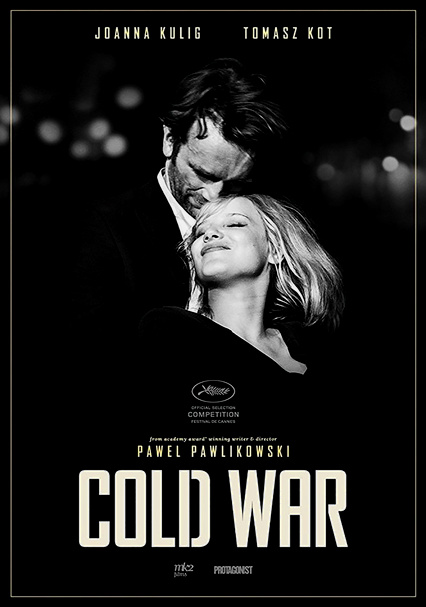
Cold War-2018
Director Pawel Pawlikowski
Starring Joanna Kulig, Tomasz Kot
Scott’s Review #861
Reviewed January 29, 2019
Grade: A
Every once in a long while, a modern film set in a different time embodies that era with such authenticity and grace that we forget that it was not shot when the story is told.
Cold War (2018) is one such film that dares to whisk the viewer to another world with genuine timelessness emboldened by the torturous romantic entanglements of its main characters.
Reminiscent of an Ingmar Bergman film shot in black and white, the film is lovely, tragic, and fraught with historical references. One can dissect the character nuances and atmospheric qualities encompassing the entire experience.
The film is a sum of its parts, with a painful layer of veneer immersed in all the various tidbits. Cold War contains almost no humor but rather doom and gloom.
Amid the ruins of post-World War II Poland, repressed and self-destructive musicians Wiktor (Tomasz Kot) and Zula (Joanna Kulig) forge an obsessive love affair and cannot stay away from each other despite the European cities and countries that stand in their way.
Spanning over a decade, they battle alcohol abuse, rage, and imprisonment as they traverse Poland, France, Berlin, and Yugoslavia.
Zula does obtain some success with her musicianship, but at a steep cost. She is forced to marry a hated man she does not love, many miles away from Wiktor. Still, their romance perseveres over time until the duo makes a fateful decision that leads to a profound climax.
The conclusion of the film is powerful, macabre, and emotional.
To state that Cold War is a tragedy is almost an understatement, though viewers will probably not realize this before watching the film.
When Zula auditions at a Polish house for the musically gifted and Wiktor accompanies her on the piano, sparks fly between them as they meet for the first time.
Zula appears to be a simple farm girl and sings a mountain song in duet with another girl. Spirited, Zula flirts with men but is forever drawn to Wiktor, and their chemistry runs rampant.
The direction, art direction, and cinematography are superb, offering a magnificent look to the film. The use of black-and-white filming gives the piece an immeasurably timeless quality, especially as streets and avenues in Paris emerge from time to time.
They could easily be 1950s France. The lovely halls where the pair performs add ambiance and effect, and musical treasures such as the melancholy main song, performed in multiple languages and tones, sparkle with culture.
With a runtime of only eighty-nine brief minutes, Cold War never feels rushed and compartmentalizes all that it needs to tell in this time period.
The story runs from 1949 until the early 1960s, and the film’s title is no mere accident. The historical reference is plain and obvious. The film also has a bleak and frigid quality in both its surroundings and its characters.
One worth mentioning is a rigid government man who complains that one girl in the chorus is “too dark”; the connotation is one of nationalism.
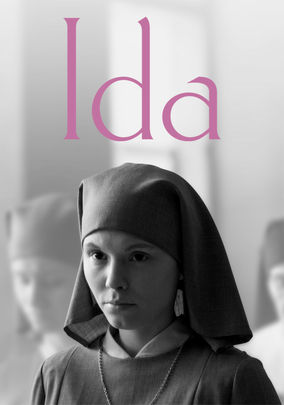
Multiple comparisons can be drawn to Pawlikowski’s masterpiece Ida (2014), one of which is that Kulig stars in both films.
In addition to the black and white shooting, both films feature a central female character that is tortured, a Nazi occupation of Poland or the after-effects of such an occupation, and the effects of repression or otherwise obsessive behavior featured in both films.
Pawlikowski is superb at crafting these damaged and conflicted characters in his films.
Director Pawlikowski successfully achieves a second Polish film offering that challenges his audiences with remarkable storytelling, a dark mood, and a reminder of the terrible effects of the aftermath of World War II and those left in its wake.
Psychological scars can wound as much as physical scars, as Pawlikowski proves in the characters he draws from and their doomed lives.
Cold War (2018) is an achievement in many ways and makes for a thoughtful conversation after the credits roll.
Oscar Nominations: Best Director- Pawel Pawlikowski, Best Foreign Language Film, Best Cinematography