The Tin Drum-1979
Director Volker Schlöndorff
Starring David Bennent, Angela Winkler
Scott’s Review #1,047
Reviewed July 31, 2020
Grade: A
A fantastic and mesmerizing film experience that goes deeper than most films do, The Tin Drum (1979) takes a brutal moment in world history and turns it into a layered production.
The film brings humor morphing into tragedy and back again in the most original of ways, seen through the eyes of a young boy named Oskar (David Bennent), who decides to physically grow no further than three years old in an allegory of political turmoil amid World War II.
The film is riddled with thought-provoking themes and historical significance, resulting in brilliance.
The film begins in 1899 and ends in the early 1940s. The story hilariously opens in the Polish lands, where Oskar’s grandfather meets his grandmother while fleeing the police.
Their tryst in a potato field produces Oskar’s mother, Agnes (Angela Winkler). She is then later torn between two men, her cousin Jan (Daniel Olbrychski) and Alfred Matzerath (Mario Adorf), whom she marries.
Oskar is born into a situation where his parentage is in question, as Agnes continues to have an affair with Jan throughout the years. Oskar’s grandfather flees to America and becomes rich without family.
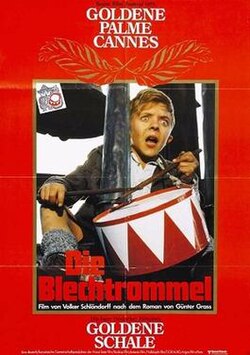
When Oskar turns three, he is given a tin drum as a present that he adores and refuses to part with. He throws himself down the cellar stairs, much to his family’s chagrin, and develops the uncanny ability to shatter glass by screaming at a high pitch.
As the 1930s become the 1940s, Oskar witnesses his mother’s affair, her tragic death, his father’s and uncle’s deaths, and a beloved Jewish man committing suicide rather than being caught by the Nazis.
He finds love with a sixteen-year-old shop girl named Maria and may or may not father her baby.
The Tin Drum is not always an easy watch and teeters between fun and frightening. Oskar is not the lovable kid next door that everyone adores. He is creepy-looking and unattractive at first glance, almost demonic.
Actor David Bennent is perfectly cast and has a way of offering moments where he stands transfixed, mouth dropped open, taking in the action and making gazing observations.
Oskar goes from three years old at the beginning of the film to a grown man by the end, but never changes his appearance.
Some viewers may be bothered by certain scenes. Bennent was only eleven years old and suffered from a growth defect in real life. More prudish viewers may find the youngster’s intimacy a bit shocking since he appears nude and beds a woman in full view.
I found it in no way gratuitous or exploitative and would argue that it is vital to show the growth and maturation of little Oskar.
International films typically get away with more sex and nudity than American films, but the scenes are artistic and beautiful.
The pacing in The Tin Drum is terrific. At two hours and forty-three minutes, there is plenty of time to explore relevant scenes and sequences, slowly letting them brew and marinate.
The comedy of Oskar’s grandparents’ sexual appetites beneath her big dress is hilarious and reminiscent of Federico Fellini’s best films.
The intriguing dwarf characters that Oskar meets and befriends bring life and zest to the film as they embrace their peculiarities and profit from them, encouraging them to do the same.
The second half of The Tin Drum turns dark.
Agnes, now pregnant, vomits after witnessing an eel being collected on the beach. When they are prepared for dinner, she at first resists, then embarks on a fish-eating obsession, resulting in her untimely death.
Is this an example of showing Germans stuffing themselves with Nazism? The deaths of Jan, Alfred, and others follow in rapid succession as clips of the Nazi occupation are featured.
A valuable history lesson is offered when The Tin Drum incorporates real-life footage of Adolph Hitler. Most frightening is a clip of him outside the Eiffel Tower in Paris. How he overtook this magical city and almost destroyed it is unfathomable.
This perfectly counterbalances the fairy-tale ridiculousness of other scenes, bringing home the terrible message that much of what the film explores is based on true events.
The greatness that oozes from The Tin Drum (1979) is layered and dynamic. The filming is mostly in West Germany, with some shots in Poland, which lends authenticity to the experience. Other offerings are surrealistic, sometimes child-like in innocence, sometimes tragic, and too realistic.
The picture drizzles with life, energy, synergy, and multi-faceted character relationships. One of the greats to watch more than once to grasp the numerous things going on.
The film is adapted from the novel of the same name by Günter Grass.
Oscar Nominations: 1 win-Best Foreign Language Film (won)